Featured Answer: To start a veterinary PCD pharma franchise in India, you need a wholesale drug licence, GST registration, storage space and a written agreement with an animal-health company that gives you a defined territory. Check product range, manufacturing documents, MOQ and monopoly terms first, place a small first order, then build relationships with vets, dairy farmers and agro-vet stores.
What Is a Veterinary PCD Pharma Franchise?
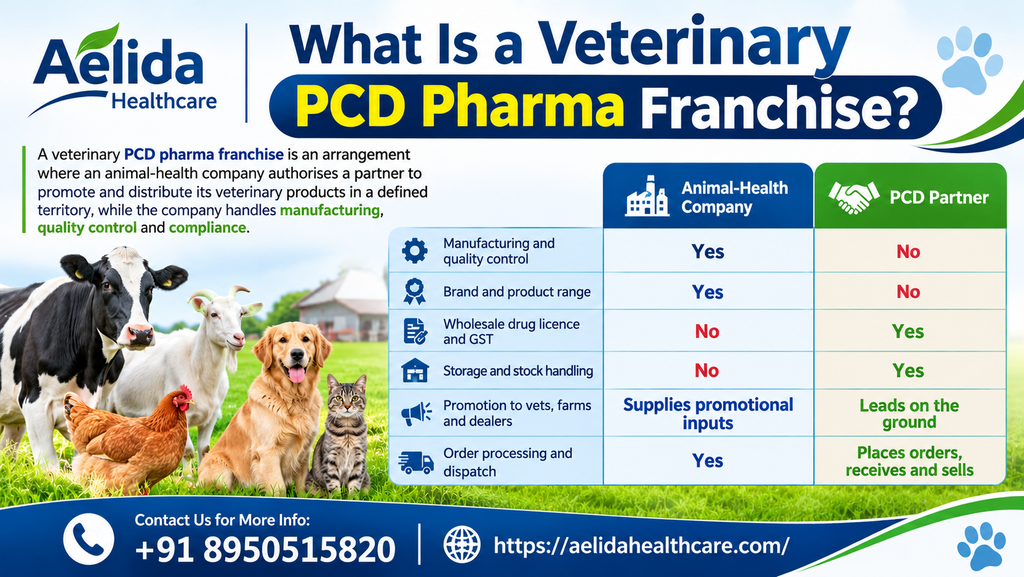
Takeaway: A veterinary PCD pharma franchise is an arrangement where an animal-health company authorises a partner to promote and distribute its veterinary products in a defined territory, while the company handles manufacturing, quality control and compliance.
PCD stands for Propaganda Cum Distribution. “Propaganda” here is old pharma-trade shorthand for promotion: meeting vets, farm owners and dealers, and keeping shelves stocked. “Distribution” is the selling and delivery side. The partner doesn’t run a plant. The partner runs a territory.
| Task | Animal-health company | PCD partner |
|---|---|---|
| Manufacturing and quality control | Yes | No |
| Brand and product range | Yes | No |
| Wholesale drug licence and GST | No | Yes |
| Storage and stock handling | No | Yes |
| Promotion to vets, farms and dealers | Supplies promotional inputs | Leads on the ground |
| Order processing and dispatch | Yes | Places orders, receives and sells |
Who Can Start a Veterinary PCD Franchise?
Takeaway: No specific degree is required to become a veterinary PCD partner, but the wholesale drug licence needs suitable premises and a competent person, so that requirement decides who can actually start.
Companies rarely ask for a degree. The law asks for something different. According to the Drugs and Cosmetics Rules, 1945, a wholesale drug licence is issued by the State Licensing Authority and requires adequate premises plus a competent person supervising sales. Confirm the current criteria with your State Drugs Control office before you sign a rent agreement.
People who start well usually come from a few backgrounds: veterinarians and para-vets, agro-vet and animal-feed dealers, medical representatives moving into animal health, and distributors adding a veterinary line. The ones who struggle are first-timers with no farm or clinic contacts who expect orders to arrive on their own.
Products You Can Sell in a Veterinary PCD Franchise
Takeaway: Veterinary PCD ranges typically cover boluses, injectables, oral liquids, dewormers, mineral and calcium supplements, feed supplements, skin and wound care, and pet products, and the range differs from company to company.
| Category | Typical use | Main customers |
|---|---|---|
| Boluses and tablets | Livestock dosing | Vets, dairy farmers |
| Injectables | Treatment where a vet advises injection | Vets, large farms |
| Oral liquids and suspensions | Dosing across species | Vets, farms, agro-vet stores |
| Dewormers | Parasite control | Farmers, vets |
| Mineral mixtures, calcium and vitamins | Nutritional support | Dairy farmers, poultry farms |
| Feed supplements | Supporting animal nutrition | Dairy and poultry farms |
| Skin, wound and fly-control products | External care | Farmers, vets |
| Pet healthcare products | Dogs, cats and other companion animals | Pet clinics, pet shops |
Always verify composition, indication, dosage and availability with the manufacturer’s product documents. A product list is a starting point, not a recommendation.
Veterinary PCD vs Human-Medicine PCD
Takeaway: Veterinary PCD differs from human-medicine PCD in who buys, when demand peaks and which safety rules apply, so a partner should plan around farms, seasons and withdrawal periods rather than copying a human-pharma playbook.
| Factor | Veterinary PCD | Human-medicine PCD |
|---|---|---|
| Who decides what is bought | Vets, but also farm owners and agro-vet dealers directly | Mostly doctors prescribing, chemists dispensing |
| Demand pattern | Seasonal and species-driven (dairy, poultry, pets) | More spread across the year |
| Customers per territory | Fewer but larger buyers (farms, dairies) plus many small farmers | Many clinics and chemists |
| Special safety point | Withdrawal periods for milk and meat in food-producing animals | Standard prescription norms |
| Best fit for | Partners with farm, dairy or poultry access | Partners with doctor and chemist access |
The withdrawal period deserves attention. For animals that produce milk or meat, a product may require a waiting period before milk or meat is safe to use. Certain antimicrobials are also restricted in food-producing animals in India. A partner who can’t explain this to a farmer shouldn’t sell that product, so ask every company for clear usage guidance on each item.
Step-by-Step: How to Start a Veterinary PCD Franchise in India
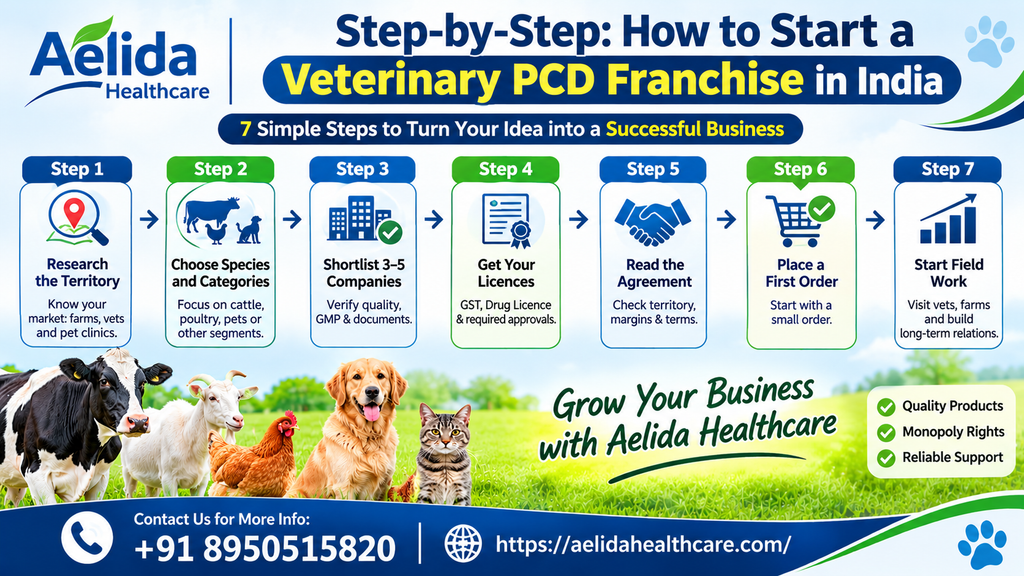
Takeaway: Seven steps take a partner from idea to first sale: research the territory, choose species and categories, shortlist and verify companies, get licences, review the agreement, place a small first order, and start field work.
Step 1: Research the territory
Find out which animals dominate your district. Count dairy farms, poultry units, vet clinics, pet clinics and agro-vet stores, then note which diseases and seasons drive purchases. A dairy-heavy district and a poultry belt need different product mixes. Cover a district you can actually visit regularly.
Step 2: Choose species and categories first
Decide whether you’ll focus on cattle and buffalo, poultry, small ruminants or pets before you pick a company. A catalogue of hundreds of products is useless if the ones you can sell sit in a segment your territory doesn’t have. Pick two or three categories you can explain confidently to a farmer.
Step 3: Shortlist 3–5 companies and verify each one
Ask every shortlisted company for manufacturing licence details, current GMP certificate, product documents, price list and a draft agreement. Don’t rely on a logo on a website. The checklist later in this guide shows exactly what to ask and when to walk away.
Step 4: Get your licences and registrations
| Category | Documents |
|---|---|
| Identity and address | Aadhaar, PAN, passport-size photographs |
| Business registration | GST registration; firm registration if applicable (proprietorship, partnership or company); local trade licence where required |
| Drug licence | Wholesale licence (Form 20B and 21B) from the State Licensing Authority; premises proof, layout and competent person’s qualification documents |
| Banking | Account details and cancelled cheque |
Start the licence file while you’re still shortlisting companies, because approval time is outside your control. Feed and nutritional products may fall under different rules than medicines, so ask the company and your local authority which registrations apply to the exact products you plan to sell.
Step 5: Read the agreement before you pay anything
Check these clauses line by line: the exact territory, whether it is exclusive, the duration, any sales targets, the minimum order value, price and margin terms, how near-expiry stock is handled, which promotional inputs are free, and how either side can terminate.
Step 6: Place a small first order
Order below the company’s highest slab. One reorder from a dealer or farm tells you more about demand than any projection in a brochure. Start with the fast-moving, familiar categories for your territory.
Step 7: Start field work
Visit vets, farms, dairies and agro-vet stores on a fixed route, keep a contact list and follow up within a week. Many sales in veterinary PCD come through repeat dealer orders and farmer word of mouth, so reliability of supply counts as much as the product.
How Much Does It Cost to Start a Veterinary PCD Franchise?
Takeaway: No single investment figure applies to every veterinary PCD franchise; the total depends on the company’s minimum order value, your territory, your premises and the working capital you carry before dealers and farms start reordering.
| Cost head | Nature | What drives the number |
|---|---|---|
| Licence and registration fees | One-time, with periodic compliance | State fee schedule and your business structure |
| First stock order | Per order | Company’s MOQ and your product mix |
| Storage space | Recurring | Rent, size and storage conditions the products need |
| Promotion | Ongoing | Catalogues, samples and what the company supplies free |
| Travel and logistics | Ongoing | Distance to farms and villages, visit frequency |
| Working capital | Ongoing | Credit you give dealers and farms, and how fast stock turns |
Most new partners budget for the first order and forget the gap between stocking and getting paid. In farm and dealer business, credit periods can stretch that gap, so cash gets tight there, not at the licence counter.
Here’s a quick illustration with made-up numbers, not Aelida rates. A company supplies a product at a net rate of ₹55 and you sell it to an agro-vet dealer at ₹70. Your gross margin is ₹15 per unit, about 21% of your selling price, before travel, salaries and expired stock. Aelida’s website offers a Profit Margin Calculator, a PTR/PTS Calculator and a New MRP Calculator so you can run your own figures.
Monopoly Rights: What the Agreement Should Say
Takeaway: Monopoly rights mean the company appoints only one partner for a defined area and product range, and the protection is real only if the agreement names the territory, the products and the duration in writing.
Before you rely on the word “monopoly”, confirm six things:
- Geography: which district or state, described clearly enough to settle a dispute.
- Product scope: all products, or only selected divisions or species ranges.
- Duration: how long the rights last and how renewal works.
- Conditions: whether missing a sales target cancels exclusivity.
- Exceptions: whether the company can supply large farms, dairies or institutions directly in your area.
- Written form: a verbal promise is not an agreement.
Here’s the nuance people skip. Exclusive rights don’t create demand. A district with exclusive rights to 30 products you can’t sell is worth less than shared rights to five products you move every week. Judge monopoly together with product fit, not on its own.
10-Point Checklist to Compare Veterinary PCD Companies
Takeaway: Ten checks on licences, certification, territory terms, MOQ, returns, dispatch, support and product fit separate a dependable veterinary PCD company from one that only advertises well.
| S. No | Check | Ask for | Walk away if |
|---|---|---|---|
| 1 | Manufacturing licence | Licence details you can verify with the state authority | The company won’t share them |
| 2 | GMP certification | Current certificate; read the issuing body, scope and validity date | It is expired or covers a different site |
| 3 | Monopoly terms | A written clause with territory and product scope | You only get verbal assurance |
| 4 | MOQ and first order | Minimum order value in writing | The figure changes after your enquiry |
| 5 | Net rates and margin | Full price list with PTR, PTS and MRP | Nobody can explain the margin |
| 6 | Product mix | List by species and category | Most items don’t match your territory’s animals |
| 7 | Usage guidance | Dose, indication and withdrawal-period information per product | Guidance is missing or vague |
| 8 | Expiry and returns | A written near-expiry policy | There is no policy |
| 9 | Dispatch and support | Dispatch time, tracking and a named account manager | No contact route after payment |
| 10 | References | Existing partners you can call | The company avoids references |
One more practical point. A GMP certificate tells you about the manufacturing site, not about how well the company supports you in the field. Check both.
When a Veterinary PCD Franchise May Not Work for You
Takeaway: A veterinary PCD franchise tends to fail when the partner lacks working capital, has no access to farms or vets, or signs an agreement without checking territory, MOQ and returns terms.
- You need steady income from month one. Trust with farms and dealers takes time, and early months are mostly building.
- You can’t travel regularly. Farms are spread out, and a territory you don’t cover is one a competitor will.
- You pick on the lowest rate alone. A cheap net rate on products your animals’ owners won’t buy is no bargain.
- You over-order before the season. Unsold stock near expiry eats margin quickly.
- You cut corners on compliance. Operating without a valid licence or storing products improperly creates legal and quality risk.
Partner feedback helps, too. Aelida’s website carries partner testimonials and reviews. Read them as one signal, then ask any company, including Aelida, for references you can call yourself.
Partnering With Aelida Healthcare
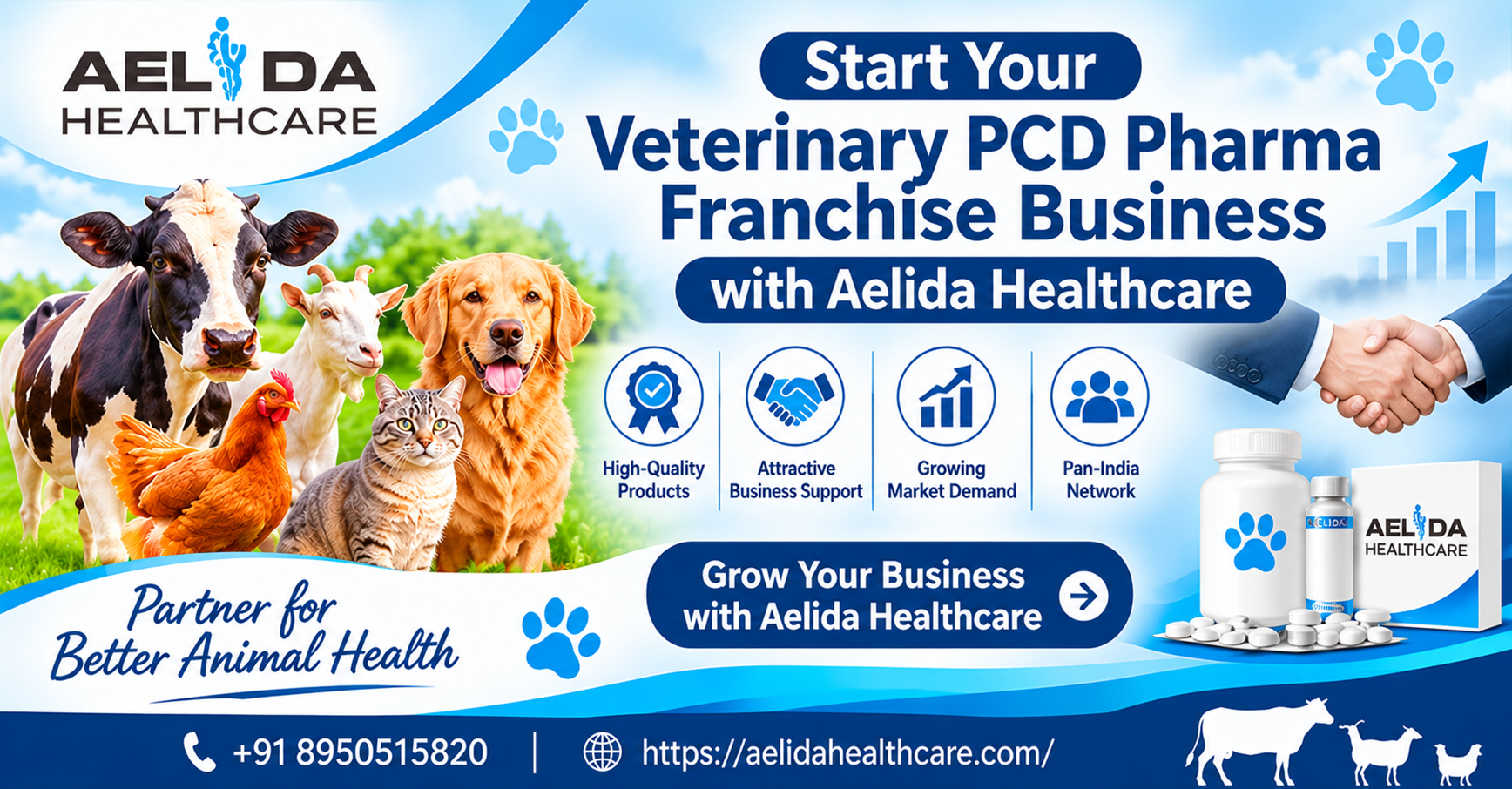
Takeaway: According to its website, Aelida Healthcare is an Ambala Cantt (Haryana) based company, operating since 2004, that offers PCD partners monopoly district rights, same-day order dispatch, a dedicated account manager and ready promotional inputs.
Everything below comes from Aelida Healthcare’s website. Verify specifics, including certificates and the veterinary range, directly with the company before signing.
- Product range: 1,500+ products across multiple divisions.
- Quality and compliance: the company states its plant follows EU PICS and UK MHRA GMP standards and that its formulations are WHO-GMP compliant. Ask to see the certificates.
- Territory: monopoly district rights for franchise partners.
- Order handling: same-day dispatch, with billing, dispatch and tracking updates by email, SMS and WhatsApp.
- Account management: a single point of contact for queries and complaints.
- Promotional inputs: LBL, visual aids, pens, keychains, MR shirts, laptop bags and doctor gifts.
- Digital tools: a mobile app for ordering, payments, ledger access and complaints, plus margin, PTR/PTS and MRP calculators.
The enquiry form asks whether you hold a drug licence, so tell the team where you are in the process. You can reach Aelida Healthcare at +91 8950515820 or info@aelidahealthcare.com, Monday to Saturday, 9 AM to 6 PM. The address is 21, Vita Enclave, Dhulkot, Behind Kingfisher Hotel, Ambala Cantt – 134003, Haryana. Start from the Partnerships or browse the product list.
Your First 90 Days: A Practical Plan
Takeaway: The first 90 days work best in three phases: set-up and verification in month one, a small first order and territory mapping in month two, and reorder tracking in month three.
- Days 1–30: apply for the wholesale drug licence, finish GST, shortlist companies, verify documents and read the draft agreement.
- Days 31–60: sign, place a modest first order, map every vet, farm cluster, dairy and agro-vet store in your territory, and begin visits.
- Days 61–90: review which products reordered, drop what didn’t move, adjust the second order for the coming season, and ask your account manager for support on weak spots.
Key Takeaways
- A veterinary PCD franchise lets you sell an animal-health company’s products in a defined territory without manufacturing.
- You need a wholesale drug licence and GST registration before you can operate.
- No universal investment figure exists; budget for the first order plus working capital and dealer credit.
- Monopoly rights only protect you if territory, products and duration are written in the agreement.
- Veterinary demand is seasonal and species-driven, and withdrawal periods matter for milk and meat animals.
- Verify licences and GMP certificates yourself before paying anything.
FAQs
Q1. What is a veterinary PCD pharma franchise?
Ans. It is a business model where an animal-health company gives a partner the right to promote and distribute its products in an agreed territory. PCD stands for Propaganda Cum Distribution.
Q2. Which licence do I need to start a veterinary PCD franchise?
Ans. You need a wholesale drug licence (Form 20B and 21B) from your State Licensing Authority, plus GST registration. Feed and supplement products may need other registrations, so confirm with the company and local authority.
Q3. Can I start without a drug licence?
Ans. You can research and shortlist companies without one, but you can’t legally distribute medicines wholesale without it. Many companies also ask for a licence copy before the first order.
Q4. How much investment does a veterinary PCD franchise need?
Ans. There is no single figure. The total depends on the company’s MOQ, your premises, promotion costs and working capital, so ask for the minimum order value in writing.
Q5. Is a veterinary PCD franchise profitable?
Ans. Profit depends on product demand, season, net rates, territory coverage and operating costs. No profit level should be assumed.
Q6. What products are sold in a veterinary PCD franchise?
Ans. Common categories include boluses, injectables, oral liquids, dewormers, mineral and calcium supplements, feed supplements, skin and wound care and pet products. The exact range varies by company.
Author Box
Aelida Healthcare is a pharmaceutical company based in Ambala Cantt, Haryana. According to its website, it has operated since 2004 and offers PCD franchise partnerships with a catalogue of 1,500+ products.