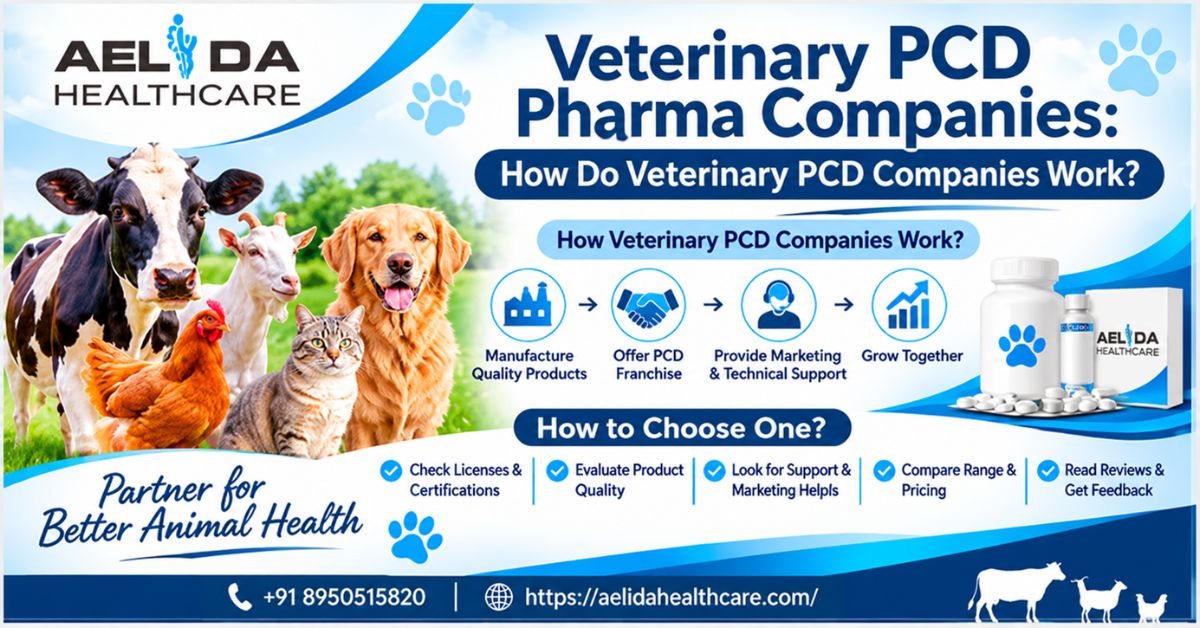
Quick answer :- A veterinary PCD pharma franchise lets you sell a manufacturer’s animal-health products under its brand in an agreed territory, without owning a factory. The company manufactures and holds the licences; you sell to veterinarians, farms and pharmacies. Your real profit depends on purchase rate, expiry losses and credit.
Most guides on this topic stop at definitions. This one goes further: it puts the published 2026 market estimates side by side, explains what the new antibiotic rules mean for the product range you can safely sell, and walks through a margin calculation you can redo with your own numbers. Every figure below is either attributed to a named source or labelled as an illustrative assumption.
What is a veterinary PCD pharma franchise?
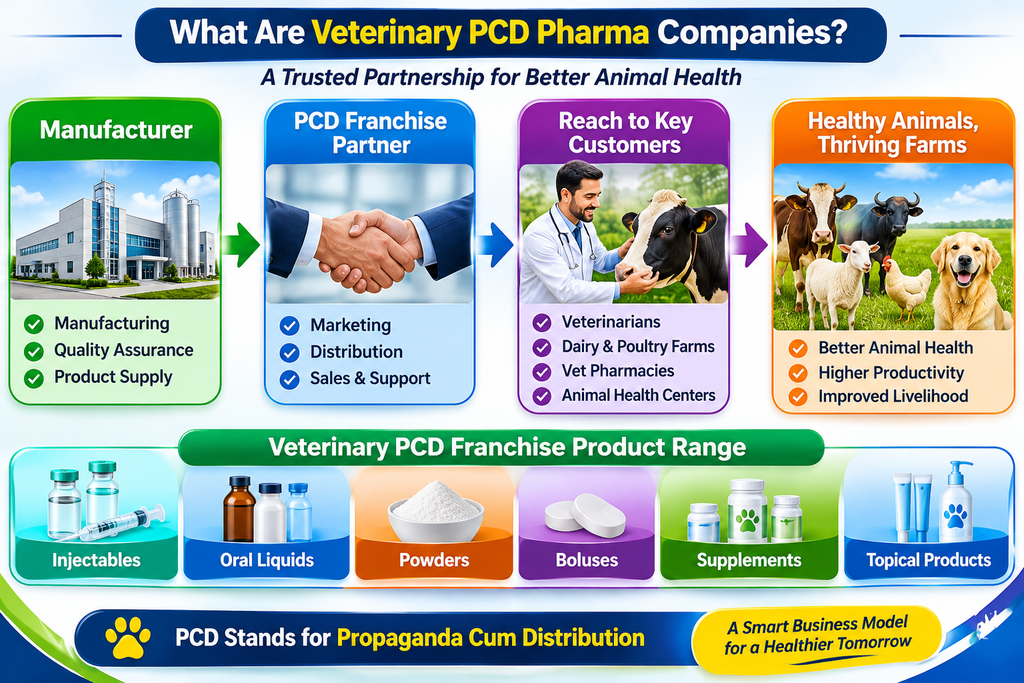
Takeaway: A veterinary PCD (Propaganda Cum Distribution) franchise is a contract in which an animal-health manufacturer gives a partner the right to promote and sell its branded products in a defined territory, while the manufacturer handles production, licences and quality.
The partner builds relationships with veterinary doctors, dairy farms, poultry units and animal pharmacies. The manufacturer supplies stock, packaging, visual aids and literature. The partner earns the difference between the purchase rate and the selling price.
Understanding PTR, PTS and MRP. MRP is the maximum retail price printed on the pack. PTR (Price to Retailer) is what a retailer pays. PTS (Price to Stockist) is what a stockist pays. In a PCD deal, your purchase rate from the company sits at or near the PTS level, and your margin depends on where you sell in that ladder.
PCD vs other business models
| Factor | PCD franchise | Third-party manufacturing (own brand) | Own manufacturing plant | Stockist / distributor |
|---|---|---|---|---|
| Brand owner | Manufacturer | You | You | Manufacturer |
| Upfront money | Low to moderate | Moderate to high | Very high | Moderate (stock-heavy) |
| Time to first sale | Weeks | Months (batch, labels, approvals) | 1 year or more | Weeks |
| Formulation control | None | High | Full | None |
| Territory protection | By contract | Not applicable | Not applicable | Usually by appointment |
| Main risk | Weak company or unwritten territory | Minimum order quantities, unsold stock | Capital, compliance | Thin margin, credit exposure |
| Best for | New entrants with local vet contacts | Established marketers | Large groups | Existing wholesalers |
Veterinary pharma market in India: 2026 data
Takeaway: Published estimates of India’s veterinary drug market range from about USD 0.5 billion to USD 2.3 billion for 2025-26, with forecast growth between 5.4% and 10.4% a year, because each publisher counts a different scope.
Anyone quoting a single market size is picking one report. The table lists what each named publisher states, so you can see the spread yourself.
| Publisher | What it measures | Base value | Forecast | Stated CAGR |
|---|---|---|---|---|
| IMARC Group | Veterinary pharmaceuticals | USD 1,242.5 million (2025) | USD 2,308.4 million (2034) | 6.91% (2026-2034) |
| IMARC Group | Veterinary medicine | USD 918.47 million (2025) | USD 1,580.43 million (2034) | 5.38% (2026-2034) |
| Mordor Intelligence | Veterinary healthcare | USD 1.76 billion (2026) | USD 2.66 billion (2031) | 8.64% (2026-2031) |
| Ken Research | Animal health and veterinary care | USD 2.29 billion (2025) | USD 3.91 billion (2031) | 9.33% (2026-2031) |
| Expert Market Research | Veterinary drugs | USD 1.78 billion (2025) | USD 4.79 billion (2035) | 10.40% (2026-2035) |
| MarketsandMarkets | Veterinary pharmaceuticals | USD 515.6 million (2026) | USD 809.8 million (2031) | 9.5% (2026-2031) |
Understanding the Market Data. The gap probably reflects scope: some reports count drugs only, others add vaccines, diagnostics and services. For a PCD partner, the drugs-only figures are the relevant ones. All six publishers agree on direction (growth), and none of them forecasts your district. Use the numbers to judge the category, then do your own territory work.
A summary of IMARC’s India veterinary medicine report, published through OpenPR, reports these segment shares: drugs hold 57.1% of the product segment, livestock animals 54.7% of the animal-type segment, parenteral (injectable) products 46.2% of routes of administration, veterinary hospital pharmacies 34.8% of distribution, and North India 30.5% of regional revenue.
What the animal population says
According to the 20th Livestock Census (Department of Animal Husbandry and Dairying, 2019), India holds 535.78 million livestock, and demand for veterinary products follows these animals.
| Species | Population (20th Livestock Census, 2019) | What it means for a PCD partner |
|---|---|---|
| Cattle | about 192.5 million | Dairy and breeding products, injectables, supplements |
| Buffaloes | 109.85 million | Dairy-belt demand, reproductive and metabolic products |
| Goats | 148.88 million | Fragmented small-holder buyers, lower ticket size |
| Sheep | 74.26 million | Seasonal, region-specific demand |
| Poultry | 851.81 million (534.74 million commercial) | Large buyers, longer credit, tighter price pressure |
| Pigs | 9.06 million | Niche |
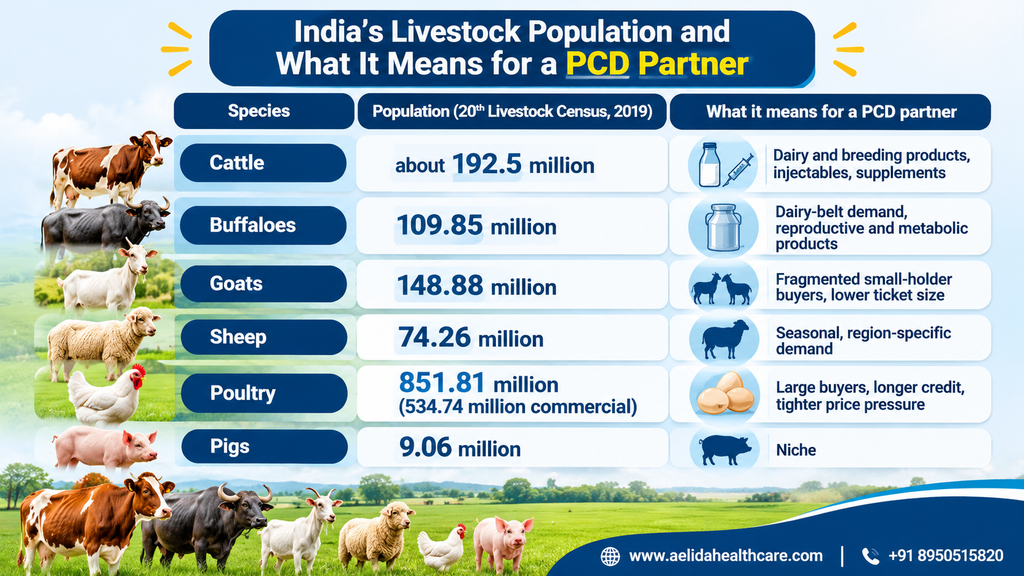
The census also records 125.34 million milch cows and buffaloes. Uttar Pradesh (about 68 million), Rajasthan (56.8 million) and Madhya Pradesh (40.6 million) hold the largest livestock populations. The census is from 2019, so treat district counts as a starting point and cross-check with your local animal husbandry office.
2026 regulation changes
Takeaway: Between 2024 and 2026, India tightened antibiotic rules for food-producing animals, so a PCD company’s product list now needs to be checked against banned molecules before you sign.
| Date | Development | Source |
|---|---|---|
| 2019 | Health Ministry banned colistin for food-producing animals | Business Standard / PTI report |
| Oct 2024 (effective Apr 1, 2025) | FSSAI amended residue regulations, listing antimicrobials not permitted in production of milk, meat, poultry, eggs and aquaculture | Down To Earth |
| Feb 11, 2026 | Ministry of Fisheries, Animal Husbandry and Dairying notified a coordinated framework for veterinary medicines; DAHD’s Empowered Committee on Animal Health-Regulatory advises CDSCO | TeamLease RegTech |
| Mar 12, 2026 | Health Ministry prohibited import, manufacture, sale and distribution of chloramphenicol and nitrofuran-class drugs for food-producing animals | Outlook India |
| Jun 4, 2026 | India added to the EU list of countries authorised to export food-animal products (Regulation (EU) 2026/1189) | Down To Earth |
| Sep 3, 2026 | CDSCO published a draft notification to prohibit carboxypenicillins and phosphonic acid derivatives for animal use (still a draft) | Outlook India, Business Standard |
What This Means for Veterinary PCD Partners. Ask every company for a product-wise composition sheet and check each antibiotic against the current banned list. CDSCO has also directed state drug controllers to step up inspections of veterinary medical shops, so a distributor holding a banned molecule carries real licence risk. Residue rules also mean farmers increasingly ask about withdrawal periods (the days a treated animal’s milk or meat must be kept out of the food chain). A partner who can quote the label’s withdrawal period earns trust faster than one who cannot.
Real profit margin: the math
Takeaway: A veterinary PCD partner’s net margin is usually a fraction of the headline margin, because freight, expiry, returns, credit losses and field costs are paid out of gross profit.
The model below is illustrative. The inputs are assumptions, not industry-reported figures, because no public source publishes veterinary PCD rate cards. Replace the purchase rate with the number in your company’s rate card, and rerun it with the profit margin calculator and the PTR/PTS calculator.
Financial Model Assumptions: product MRP ex-GST of 100; you sell at 70 (30% below MRP, covering the retailer or clinic discount); monthly sales of Rs 3,00,000 at your selling price; one field executive.
Step 1: margin per unit
| Item (per Rs 100 MRP) | Low case | Mid case | High case |
|---|---|---|---|
| Your purchase rate | 56.0 | 52.5 | 49.0 |
| Your selling price | 70.0 | 70.0 | 70.0 |
| Gross profit | 14.0 | 17.5 | 21.0 |
| Gross margin on sales | 20% | 25% | 30% |
| Markup on cost | 25.0% | 33.3% | 42.9% |
The last two rows are the most common source of confusion. A company that says you earn 33% may mean markup on cost, while 25% is the same deal expressed as margin on sales. Ask which one is being quoted.
Step 2: monthly profit and loss at Rs 3,00,000 sales
| Line | Low | Mid | High |
|---|---|---|---|
| Gross profit | Rs 60,000 | Rs 75,000 | Rs 90,000 |
| Field executive salary | Rs 18,000 | Rs 18,000 | Rs 18,000 |
| Travel and fuel | Rs 8,000 | Rs 8,000 | Rs 8,000 |
| Samples, promotion, phone | Rs 4,000 | Rs 4,000 | Rs 4,000 |
| Compliance, accounts, misc. | Rs 3,000 | Rs 3,000 | Rs 3,000 |
| Freight (1.5% of sales) | Rs 4,500 | Rs 4,500 | Rs 4,500 |
| Expiry and returns (2%) | Rs 6,000 | Rs 6,000 | Rs 6,000 |
| Bad debt and credit loss (1.5%) | Rs 4,500 | Rs 4,500 | Rs 4,500 |
| Net profit | Rs 12,000 | Rs 27,000 | Rs 42,000 |
| Net margin on sales | 4% | 9% | 14% |
Step 3: break-even and sensitivity
Fixed costs are Rs 33,000 a month and variable costs are 5% of sales, so break-even monthly sales equal Rs 33,000 divided by (gross margin minus 5%).
| Case | Break-even monthly sales |
|---|---|
| Low (20% gross) | Rs 2,20,000 |
| Mid (25% gross) | Rs 1,65,000 |
| High (30% gross) | Rs 1,32,000 |
| Mid case at different sales | Rs 1,50,000 | Rs 3,00,000 | Rs 6,00,000 |
|---|---|---|---|
| Net profit | Rs -3,000 | Rs 27,000 | Rs 87,000 |
The jump from loss to profit comes from fixed costs, which is why the first year depends on how quickly your sales reach break-even.
Step 4: the number most guides skip, working capital
In the Mid case, monthly purchases are Rs 2,25,000 (75% of sales). Holding 1.5 months of stock needs about Rs 3,37,500, and 30 days of credit to clinics and farms ties up another Rs 3,00,000. Working capital comes to roughly Rs 6.4 lakh, less any credit the company gives you. Rs 27,000 a month on that capital is about 4.2% a month, before your own time. The constraint for most partners is cash, not margin percentage.
Counterintuitive point: the highest margin product is not always the best earner. Gross profit per rupee of stock per year is roughly markup multiplied by stock turns. A 42.9% markup product that turns 3 times a year earns about 129 paise per rupee of stock. A 25% markup product that turns 6 times earns 150 paise. A slow, short-dated item with a rich margin can lose to a fast mover with a modest one.
GST Considerations. According to a Tally Solutions summary of the 56th GST Council decisions, most medicaments under HSN 3004 attract 5% GST from September 22, 2025, down from 12%. The rate is product-specific, so check each product’s HSN code on the GST portal before invoicing.
How to choose a territory
Takeaway: Choose a district by animal density, veterinary access and competition together, not by where you happen to live.
| Factor | What to check | Why it matters |
|---|---|---|
| Animal base | Milch animals or commercial poultry per district (state animal husbandry office) | Sets the ceiling for sales |
| Buyer type | Clinics, dairy cooperatives, poultry integrators, pharmacies | Poultry integrators demand longer credit |
| Your access | Veterinarians and farm owners you can meet in week one | Relationships decide year-one sales |
| Competition | Number of established veterinary brands already supplying local shops | Crowded districts need a sharper product range |
| Logistics | Road time to the nearest depot or company warehouse | Delays cause stock-outs and returns |
The largest state is not automatically the best choice. A mid-sized district with dense dairy activity and a partner who already knows its veterinarians usually outperforms a huge district where nobody knows you.
Licences and documents
Takeaway: Veterinary drugs are regulated under the Drugs and Cosmetics Act, 1940, so both the company and the partner need valid licences, and the partner should verify the company’s before paying.
| Who | Document | Notes |
|---|---|---|
| Company | Manufacturing licence from the State Licensing Authority | Ask for the number and verify with the authority |
| Company | Product-wise permissions; CDSCO approval for new or imported veterinary drugs | A Department of Animal Husbandry NOC is not a statutory licence and does not replace CDSCO approval |
| Company | GMP status | If WHO-GMP is claimed, ask for the certificate and confirm the issuer |
| Partner | Wholesale drug licence under the Drugs Rules, 1945 | Premises and qualified-person rules apply; confirm requirements with your State Drug Controller |
| Partner | GST registration | Needed for invoicing |
Official Government References: CDSCO and the Department of Animal Husbandry and Dairying. For certified manufacturers, read the guide to WHO-GMP certified veterinary PCD companies in India.
How to evaluate a company veterinary PCD company
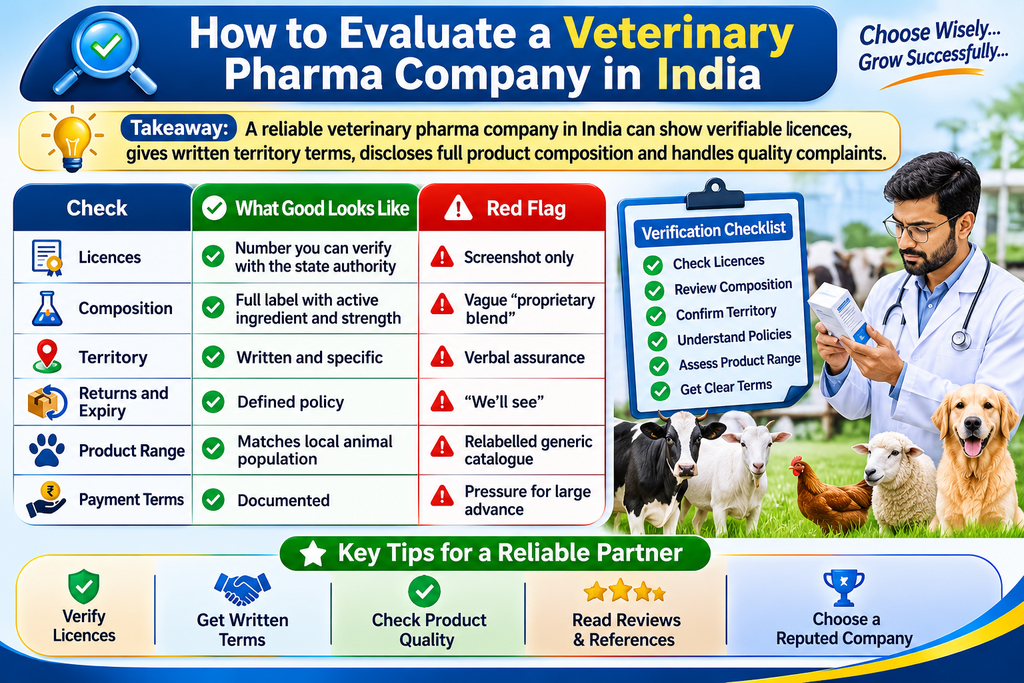
Takeaway: Score each shortlisted veterinary PCD company out of 100 on verifiable items, and walk away from any company that scores below 70 or that fails the licence check outright.
This scorecard is a practical framework, not an official standard.
| Criterion | Points | Full marks look like | Red flag |
|---|---|---|---|
| Licence verification | 20 | Number verified with the state authority | Screenshot only |
| Composition transparency | 15 | Full label with strength; no banned antibiotic | Vague proprietary blend |
| Territory clause | 15 | District or pin codes written in the agreement | Verbal promise |
| Range fit | 15 | Matches local species (dairy, poultry, small ruminants) | Generic relabelled catalogue |
| Returns and expiry policy | 10 | Written, with a defined window | We will see |
| Quality complaint process | 10 | Named contact and response time | No contact |
| Field support | 10 | Visual aids, literature, training | Stock only |
| Payment terms | 5 | Documented credit terms | Pressure for large advance |
If a facility visit is refused, treat the manufacturing claim as unverified. For the first-year sequence, see our guide on how to start a veterinary PCD pharma franchise.
Monopoly rights
Takeaway: Monopoly rights in a veterinary PCD deal mean exclusive distribution of named products in a named territory, and they exist only if the signed agreement says so.
No government body grants or protects them. Before signing, check that the agreement states the exact territory, the covered products and whether future launches are included, the targets that keep exclusivity alive, the duration and renewal terms, and what happens if the company sells directly or online in your area.
Who should not start
Takeaway: A veterinary PCD franchise is a poor fit for anyone with no access to veterinarians or farms and no cash buffer for the first six months.
PCD rewards partners who already know buyers. If you start from zero in animal health, year one is mostly relationship-building, and no agreement shortens that. It is also a poor fit if you plan to run it from a distance without field visits, or if you are choosing purely on the lowest entry cost. The model fails when the partner or the company is chosen badly, not because the model is weak.
90-day launch plan
Takeaway: A focused launch of eight to ten fast-moving products in one species segment is easier to sell, finance and review than a full catalogue.
- Days 1-15: Pick the territory with the factor table and shortlist three to five companies.
- Days 16-30: Verify licences, request composition sheets, compare rate cards, visit one facility.
- Days 31-45: Negotiate and sign the agreement with territory, returns and target clauses in writing. Apply for your drug licence and GST registration.
- Days 46-60: Place a first order sized to about six weeks of expected sales, not three months.
- Days 61-90: Visit veterinarians and shops weekly, track which products sell within 30 days, and reorder only those.
Key takeaways
- A veterinary PCD franchise lets you sell a company’s branded animal medicines in a defined territory without a factory.
- Market estimates range widely by scope; all point to growth between roughly 5% and 10% a year.
- Net margin in the worked example is 4% to 14% of sales; working capital of about Rs 6.4 lakh matters more than the margin percentage.
- Antibiotic rules tightened in 2024-2026, so check every product against the banned list.
- Monopoly rights and returns terms belong in the signed agreement.
- Pick the territory by animal density and your own access to buyers.
FAQs
Q1. What is a veterinary PCD pharma franchise?
Ans. It is an agreement in which an animal-health manufacturer lets an independent partner market and sell its products in a defined territory under the company’s brand.
Q2. Is a veterinary PCD franchise profitable?
Ans. It can be, but profit depends on your purchase rate, sales volume, expiry losses and credit. In the illustrative model above, net margin ranges from 4% to 14% of sales, and a partner below break-even sales loses money.
Q3. How much margin does a veterinary PCD partner earn?
Ans. There is no published industry figure. Margin depends on the company’s rate card and your selling price. Ask whether a quoted margin is on sales or on cost, because 25% on sales equals 33.3% on cost.
Q4. How much investment is needed?
Ans. It varies by company and territory. The main items are licences, opening stock and credit extended to buyers. In the worked example, working capital is about Rs 6.4 lakh for Rs 3 lakh of monthly sales.
Q5. Do I need a licence?
Ans. Generally yes. Selling veterinary drugs in India requires a licence under the Drugs and Cosmetics Act, 1940 and its Rules. Confirm the exact type with your State Drug Controller.
Q6. What does monopoly rights mean?
Ans. It means the company agrees not to appoint another distributor for the same products in your territory. It is a contract term and should be written into your agreement.
Q7. Are antibiotic products risky to sell now?
Ans. They can be if a product contains a banned molecule. Colistin, chloramphenicol and nitrofuran-class drugs are prohibited for food-producing animals, and two more groups are in a draft ban notification. Check every product’s composition.
Q8. PCD or third-party manufacturing, which is better?
Ans. PCD suits fast, low-capital entry. Third-party manufacturing suits established marketers who want their own brand and formulation control.
Q9. Do I need a veterinary degree?
Ans. No degree is required to be a partner, but you need access to veterinarians and farms and enough product knowledge to explain what you sell.
About the Author
Aelida Healthcare is a pharma company based in Ambala Cantt, Haryana, which, according to its website, offers PCD franchise partnerships and publishes calculators for PTR, PTS, MRP and profit margin. Verify any company’s licences independently before signing, including ours.