WHO-GMP certified veterinary PCD companies in India are pharma manufacturers that hold a valid WHO-GMP certificate and a state manufacturing licence, and that offer veterinary medicines to distributors on a Propaganda-cum-Distribution (PCD) franchise basis. Verify the certificate with the issuing authority before partnering, because a website claim alone is not proof.
A PCD (Propaganda-cum-Distribution) franchise lets you market and distribute a manufacturer’s branded medicines in an assigned territory without building a factory. In the veterinary segment, that manufacturer should be able to show a current WHO-GMP certificate, a valid drug manufacturing licence and batch-wise quality records. Those three documents separate WHO-GMP certified veterinary PCD companies in India from firms that only use the phrase in their marketing.
This guide covers what the certification means, how to check it, how PCD compares with third-party manufacturing, and where franchise partners most often go wrong. It is written for distributors, vets-turned-entrepreneurs and pharma marketers who want a partner they won’t regret in year two. If you’d like to see how an Ambala-based company structures its PCD pharma franchise partnerships, that page lays out the process.
What Is a WHO-GMP Certified Veterinary PCD Company?
Takeaway: A WHO-GMP certified veterinary PCD company manufactures animal-health products in a facility inspected against WHO-aligned Good Manufacturing Practice standards and grants franchise partners the right to market those products in a defined territory.
Two ideas sit inside that name, and people often mix them up.
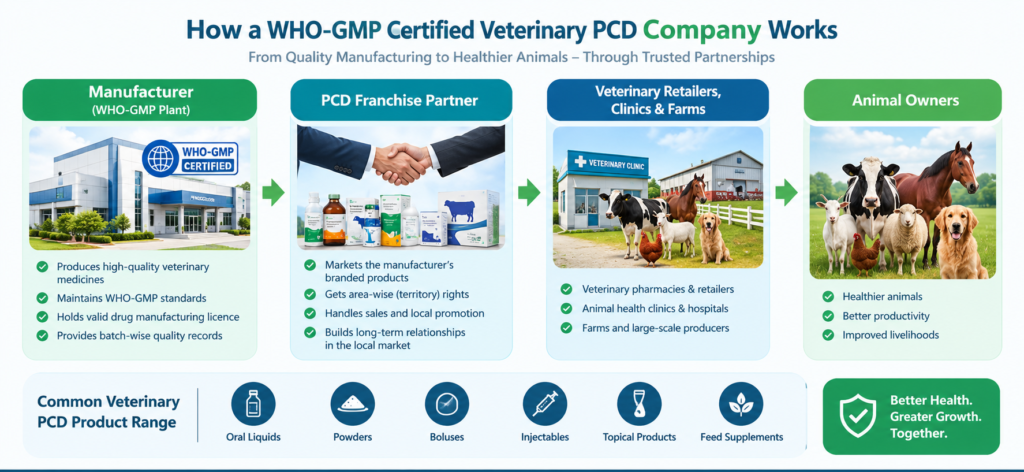
WHO-GMP describes how a plant makes medicines: its premises, equipment, documentation, personnel, quality control and hygiene. The reference text is WHO’s good manufacturing practices for pharmaceutical products: main principles (TRS 986, Annex 2). PCD describes how the company sells them: the manufacturer produces, the franchise partner promotes and distributes, and the partner usually gets area-wise rights to the brand.
Definition: PCD Pharma Franchise
A business model in which a pharma manufacturer gives a distributor the right to market its branded products in a specific district, state or region. The partner handles sales and local promotion; the manufacturer handles production, quality control and regulatory compliance.
Veterinary PCD products typically cover cattle, buffalo, poultry, goat, sheep, horse and pet-animal needs. Common forms include oral liquids, powders, boluses, injectables, topical products and feed supplements. A good company will tell you plainly which of these it makes in-house and which it sources elsewhere.
Why WHO-GMP Matters in Veterinary Medicine
Takeaway: WHO-GMP matters in veterinary medicine because consistent potency, correct labelling and contamination control protect animal health, farm productivity and your brand’s reputation as the distributor.
Veterinary buyers often assume animals are a “lower-stakes” market than human medicine. That’s a mistake. A poultry farmer who loses a flock to an under-dosed batch won’t blame the manufacturer. He’ll blame you, because you were the name on the invoice.
A few reasons the certification carries weight:
- Batch consistency. Documented process controls reduce the chance that one batch behaves differently from the last.
- Cleaner paperwork. Retailers and institutional buyers are more comfortable with suppliers who can show quality documentation.
- Regulatory direction. According to the Union Health Ministry’s December 2023 notification, the revised Schedule M under the Drugs and Cosmetics Act aligns Indian GMP requirements more closely with WHO norms, and enforcement tightened from January 2026. Manufacturers who already operate to WHO-GMP standards are better positioned for that environment. You can track official updates on the CDSCO website and the Ministry of Health and Family Welfare.
- Antimicrobial responsibility. India’s Health Ministry prohibited colistin and its formulations for food-producing animals in 2019. A manufacturer that respects such restrictions in its portfolio is showing real compliance habits, not just certificate habits.
One honest caveat: WHO-GMP certification does not prove a product works better for a given condition. It speaks to manufacturing quality, not clinical superiority. Anyone promising otherwise is overselling.
How to Verify a WHO-GMP Certified Veterinary Medicine Manufacturer
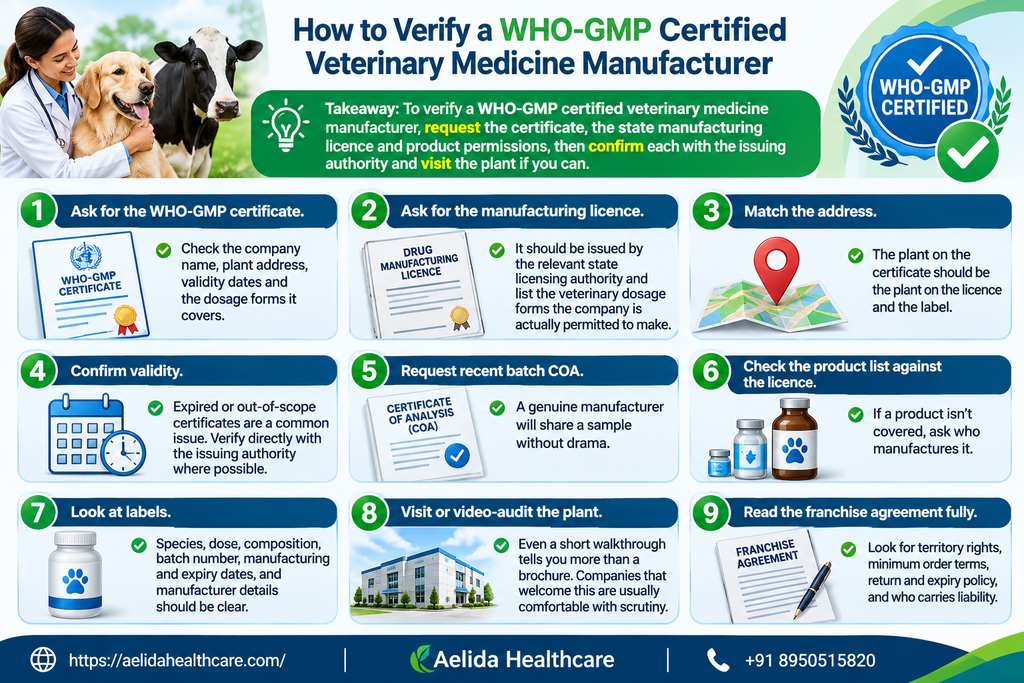
Takeaway: To verify a WHO-GMP certified veterinary medicine manufacturer, request the certificate, the state manufacturing licence and product permissions, then confirm each with the issuing authority and visit the plant if you can.
Don’t treat a logo on a homepage as evidence. Use this checklist:
- Ask for the WHO-GMP certificate. Check the company name, plant address, validity dates and the dosage forms it covers.
- Ask for the manufacturing licence. It should be issued by the relevant state licensing authority and list the veterinary dosage forms the company is actually permitted to make.
- Match the address. The plant on the certificate should be the plant on the licence and the label.
- Confirm validity. Expired or out-of-scope certificates are a common issue. Verify directly with the issuing authority where possible.
- Request recent batch Certificates of Analysis (COA). A genuine manufacturer will share a sample without drama.
- Check the product list against the licence. If a product isn’t covered, ask who manufactures it.
- Look at labels. Species, dose, composition, batch number, manufacturing and expiry dates, and manufacturer details should be clear.
- Visit or video-audit the plant. Even a short walkthrough tells you more than a brochure. Companies that welcome this are usually comfortable with scrutiny, and you can contact Aelida Healthcare to ask what documents are available.
- Read the franchise agreement fully. Look for territory rights, minimum order terms, return and expiry policy, and who carries liability.
The scale of the problem is real. According to a Business Standard report from February 2025, only around 2,000 of India’s roughly 8,500 MSME pharma units held WHO-GMP certification. Whatever your product category, that gap is the reason verification is worth the effort.
Veterinary PCD Pharma Franchise Opportunities in India
Takeaway: Veterinary PCD pharma franchise opportunities in India suit distributors who already know local vets, dairies, poultry farms and agri-retail, because relationships in those channels drive repeat orders more than advertising.
Demand comes from several directions at once: dairy and livestock owners, poultry operations, pet clinics, agri-input shops and veterinary hospitals. Each buys differently. For national context on livestock policy and schemes, the Department of Animal Husbandry and Dairying is a useful reference.
| Channel | What they care about | What helps you win |
|---|---|---|
| Dairy and livestock farmers | Price, results, trusted advice | Field-level vet relationships |
| Poultry farms | Batch consistency, bulk pricing | Reliable supply and documentation |
| Pet clinics | Brand reputation, packaging | Quality labelling, small packs |
| Agri-retail shops | Margin, stock rotation | Fast-moving range, return policy |
A practical point most guides skip: pick the channel you can reach first, then choose the franchise range to match it. Starting with the product list and hoping to find buyers later is how stock ends up near expiry. Before you commit, run the numbers with a profit margin calculator, a PTR/PTS calculator and an MRP calculator.
PCD vs Third-Party Manufacturing
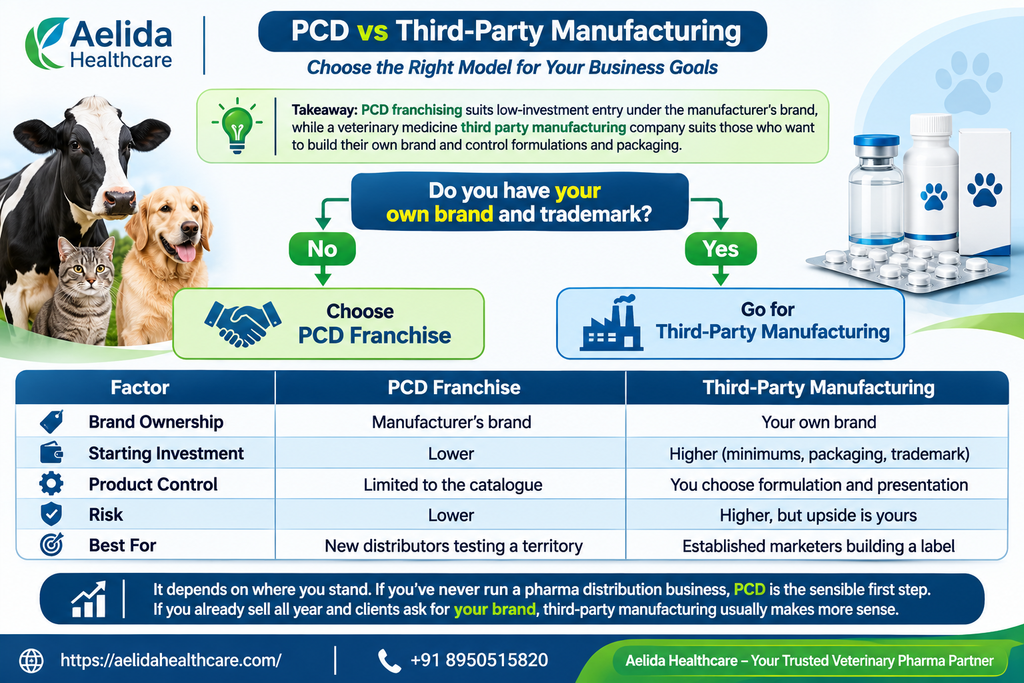
Takeaway: PCD franchising suits low-investment entry under the manufacturer’s brand, while a veterinary medicine third party manufacturing company suits those who want to build their own brand and control formulations and packaging.
| Factor | PCD Franchise | Third-Party Manufacturing |
|---|---|---|
| Brand ownership | Manufacturer’s brand | Your own brand |
| Starting investment | Lower | Higher (minimums, packaging, trademark) |
| Product control | Limited to the catalogue | You choose formulation and presentation |
| Risk | Lower | Higher, but upside is yours |
| Best for | New distributors testing a territory | Established marketers building a label |
It depends on where you stand. If you’ve never run a pharma distribution business, PCD is the sensible first step. If you already sell all year and clients ask for your brand, third-party manufacturing usually makes more sense. Some companies offer both, which lets you start with PCD and move later. Aelida Healthcare lists third-party pharma manufacturing alongside its franchise model on its homepage, and you can raise a request through the contact page.
What a Good Veterinary PCD Partner Offers
Takeaway: A reliable veterinary PCD partner combines verified certification with a clear territory policy, steady supply, marketing material, and straightforward terms on returns and expiry.
Look for these, and be a little suspicious if they’re missing:
- A clear, written monopoly or territory-rights policy
- A product range that matches your target channel
- Promotional material in regional languages
- Reasonable minimum order quantities
- Written policy on near-expiry and damaged stock
- Responsive support for technical queries from vets
- Timely dispatch and clear invoicing
Be careful with the phrase “best.” No company should call itself the best veterinary PCD pharma franchise company in India without proof, and you shouldn’t take it at face value from any source, including this one. Compare against your own criteria instead.
How Aelida Healthcare Works With PCD Partners
Takeaway: Aelida Healthcare is an Ambala Cantt-based pharma company that, according to its website, offers PCD franchise partnerships with district-level monopoly rights, promotional inputs, same-day dispatch and a dedicated account manager.
The details below come from the company’s own website, so treat them as claims to verify with documents, exactly as this guide advises for any manufacturer.
- Background: Aelida Healthcare states that it began operations in 2004 and is based in Ambala City, Haryana. Read more on the About Us page.
- Range: The company states a catalogue of 1,500+ products across multiple divisions. Browse the product catalogue.
- Quality claims: The website says its plant complies with EU PICS and UK MHRA GMP standards and that its formulations are WHO-GMP compliant.
- Partner support: The website lists monopoly district rights, promotional inputs such as visual aids and doctor gifts, same-day dispatch, a dedicated account manager and a mobile ordering app.
If you hold a drug licence and want to explore a territory, the partnership page explains how to apply.
Does Location Matter? Haryana and Ambala
Takeaway: A veterinary PCD pharma company in Haryana or Ambala may offer logistics and sourcing convenience for North Indian buyers, but location alone says nothing about quality, so verification still applies.
North India has a sizeable concentration of pharma manufacturing, and Haryana is part of it. For a distributor in Punjab, Haryana, Delhi or Himachal, a nearby manufacturer can mean shorter dispatch times and easier plant visits. That’s a real benefit.
It’s the only benefit location gives you. A company in Ambala isn’t automatically better than one in another state, and a distant plant isn’t automatically worse. Judge the paperwork, not the postcode.
Common Mistakes Franchise Partners Make
Takeaway: The most common PCD franchise mistakes are trusting claims without documents, ordering too much stock too early, and ignoring how return and expiry terms work.
- Taking “WHO-GMP certified” at face value. Always check the scope and validity.
- Choosing on margin alone. A high margin on a product vets don’t trust is a slow-moving margin.
- Overstocking in month one. Start small, watch what sells, then scale.
- Skipping the agreement. Verbal promises about territory exclusivity aren’t worth much.
- Ignoring withdrawal periods and species labels. For food-producing animals, correct use guidance protects both consumers and your reputation.
Want more guides like this? Browse the Aelida Healthcare blog.
Key Takeaways
- WHO-GMP describes manufacturing quality; PCD describes the distribution model. You need both to be right.
- Verify the certificate, the licence and the product scope before paying anything.
- PCD suits low-risk market entry; third-party manufacturing suits those building their own brand.
- Choose your sales channel first, then match the product range.
- Location, including Haryana and Ambala, helps logistics but proves nothing about quality.
- Treat “best” and “No. 1” claims as marketing until documents back them up.
FAQs
Q1. What are WHO-GMP certified veterinary PCD companies in India?
Ans. They are veterinary pharma manufacturers with a WHO-GMP certificate and valid manufacturing licence that grant distributors territory-based marketing rights under a PCD franchise model.
Q2. Is WHO-GMP certification mandatory for a veterinary PCD company?
Ans. A valid state manufacturing licence is the legal requirement for making medicines. WHO-GMP certification is a quality benchmark that many buyers and export markets expect, though revised Schedule M now pushes all manufacturers toward WHO-aligned practices.
Q3. How do I check if a WHO-GMP certificate is genuine?
Ans. Check the company name, plant address, scope and validity dates, then confirm with the issuing authority. Also compare it against the manufacturing licence.
Q4. What is the difference between PCD and third-party manufacturing?
Ans. PCD means marketing the manufacturer’s brand in your territory. Third-party manufacturing means the company makes products under your brand and label.
Q5. How much investment does a veterinary PCD franchise need?
Ans. It varies by company, product range and minimum order terms. Ask for written figures, and use the profit margin calculator to test your own numbers.
Q6. Can I get exclusive territory rights?
Ans. Many companies offer area-wise rights, but terms differ. Get the exact territory, duration and performance conditions in writing.
Q7. Is a Haryana or Ambala based company better for North India?
Ans. It can simplify logistics and plant visits. Quality still depends on certification, licences and manufacturing practice, not location.
Q8. Which animals do veterinary PCD products cover?
Ans. Typically cattle, buffalo, poultry, small ruminants, horses and pets, depending on the manufacturer’s range.
Q9. How do I contact Aelida Healthcare about a franchise?
Ans. Use the contact page or call +91 8950515820 (Mon–Sat, 9 AM to 6 PM, as listed on the website).
Author Box
Aelida Healthcare is a pharma company based in Ambala Cantt, Haryana. According to its website, the company has been operating since 2004 and offers PCD pharma franchise partnerships and third-party pharma manufacturing, with a catalogue of 1,500+ products. Franchise partners are offered district-level monopoly rights, promotional inputs, same-day dispatch and a dedicated account manager.
Interested in a franchise or manufacturing enquiry? Visit the partnership page, browse the product catalogue, or contact the team.
📍 21, Vita Enclave, Dhulkot, Behind Kingfisher Hotel, Ambala Cantt – 134003, Haryana
📞 +91 8950515820 (Mon–Sat, 9 AM to 6 PM)